

Education at the Center
Four Sub-Discourses in American Press Coverage of Chinese Children
Why education?
The first two chapters established that education was the largest theme in 1880–1885 press coverage of Chinese children. Combined, Chinese Educational Mission and Education & Schools accounted for nearly 40% of the deduplicated corpus and almost half of the circulated corpus. This chapter takes those two categories apart and asks what they actually contained, and how the four largest education-related topics behaved across time, region, and search vocabulary.
The four topics under examination are:
- Chinese Educational Mission (CEM): the Hartford government students recalled in 1881
- Public School Admission: legal battles over Chinese children's right to attend American public schools
- Classroom Instruction: descriptions of teaching, pedagogy, and what Chinese children learned
- Missionary & Church Schools: Christian institutions teaching Chinese children, especially girls
Each represents a distinct way American newspapers framed the question of Chinese childhood and schooling. Together they show how education served as the central terrain on which the larger debate about Chinese presence in America was conducted.
Four discourses, one timeline
The time series below tracks the monthly mean topic weight for all four education topics across the 1880–1885 window. Four labeled vertical lines mark key events: the CEM recall (mid-1881), the Exclusion Act (May 1882), Tape v. Hurley (early 1885), and the Rock Springs massacre (September 1885).

The Chinese Educational Mission line (orange) tells the most dramatic story. It rises sharply in mid-1881, peaks at over 50% of the monthly discourse during the recall announcements, then remains elevated through 1882 and 1883 with secondary spikes corresponding to the actual departure of students and follow-up coverage. After 1884 it never returns to its earlier height. The story has moved on; the students are gone, the controversy resolved.
The Missionary & Church Schools line (dotted blue) shows a different pattern: it sits at moderate levels throughout the period with a notable spike in 1883 corresponding to active missionary recruitment campaigns, and a sustained presence through 1884–85 as church-sponsored Chinese mission work expanded.
Public School Admission (dashed line) is largely flat through 1880–1884, then surges sharply in late 1884 and early 1885, the Tape v. Hurley moment. The court decision restructured the conversation almost overnight. Before Tape, the question of whether Chinese children could attend American public schools was a quiet one; after, it was urgent.
Classroom Instruction (teal) shows the most distinctive temporal signature. Almost absent in 1880–81, it grows steadily across 1882–84, peaking in early-to-mid 1883. This corresponds to a wave of pedagogical interest: descriptive articles about how Chinese children were taught, what they read, how mission teachers structured their lessons. The curiosity register followed the recall: once the political controversy of CEM faded, journalists turned toward the more domesticated question of what Chinese children were actually learning in American schools.
The interaction across topics is also visible. When CEM falls in 1882, the other three rise to fill the space. The total volume of education coverage stayed roughly constant; what changed was its internal composition.
Same word, different topic: how keywords shape the discourse
This heatmap restricts attention to the four education topics and shows how each of the seven search keywords loads onto them.

The diagonal of dominant cells is striking.
The keyword "Chinese student" loads almost entirely on Chinese Educational Mission (42.78), at a value almost six times its loading on any other education topic. In American 1880s usage, "Chinese student" was so closely identified with the Hartford mission that the phrase functioned as a near-synonym.
The keyword "Chinese children" loads heavily on Public School Admission (22.60), which is more than twice the corpus average. This is consistent with the fact that the Tape v. Hurley coverage and similar legal stories framed their subjects as "Chinese children", a more abstract, demographic term suited to legal argument than the specific "student" or "boy."
"Chinese girl" loads on Missionary & Church Schools (16.25). This is one of the most ideologically loaded patterns in the data: the discourse around Chinese girls in America was substantially organized by missionary institutions, which recruited female pupils for both schooling and conversion. Where Chinese boys were imagined in classrooms or workplaces, Chinese girls were repeatedly imagined in mission schools.
"Chinese school" loads on Classroom Instruction (21.39), sensibly enough, since stories about Chinese schools tended to focus on what was happening inside them.
The corpus baseline (bottom row) shows that the average article in the corpus carries about 18% weight on Chinese Educational Mission and 7% on each of the other education topics. Most keyword–topic cells are within a factor of two of this baseline. The exceptions (Chinese student × CEM at 2.4× baseline, Chinese children × Public School Admission at 2.9× baseline, Chinese girl × Missionary & Church Schools at 2.3× baseline) are the structural backbone of how the corpus organizes its discourse about Chinese children's education.
Geographic variation in the discourse
This bar chart aggregates the four education topics by U.S. Census region (West, South, Midwest, and Northeast), with each region's coverage normalized to its own sample.

The most striking pattern is the Northeast's dominance of Chinese Educational Mission coverage: over 25% of articles published in Northeastern papers focus on the Hartford mission story, more than double the rate in the West. This is geographically explicable: the CEM was headquartered in Hartford, the students lived in New England host families, and the regional press had the strongest local stake in the recall.
The South shows an unusual pattern: it has the highest rate of Missionary & Church Schools coverage (about 12%) of any region. Southern newspapers, drawing heavily on denominational publications like the Southern Christian Advocate, regularly printed material about mission work, including articles about Chinese missions in California and Chinese girls being educated in Eastern schools. The South's interest in Chinese children was filtered substantially through the Christian missionary lens.
The West is unique in giving substantial weight to Public School Admission (close to 10%). This is the Tape v. Hurley effect concentrated at the place of origin: California papers drove most of the legal coverage, and other Western papers reprinted it. The West also shows the lowest rate of Missionary & Church Schools coverage, possibly reflecting the more secular and politically combative tone of California's anti-Chinese press.
The Midwest's pattern resembles the Northeast's in shape (CEM dominant) but at a smaller magnitude across all categories; the region was a consumer of education news from elsewhere rather than a producer.
These regional differences mean that a Chinese family in late 1884 reading a Boston paper would have encountered a very different picture of "Chinese education" in America than a family reading a Charleston paper or a Sacramento paper. The four topics existed everywhere, but their relative volumes were regionally specific.
Reading the four discourses through specific articles
The patterns above acquire their full meaning only when we look at what the articles were actually saying. Each of the four discourses had its own language and its own characteristic narrative form.
The Chinese Educational Mission discourse centered on the Hartford students and their recall. The most heavily-loaded article in this topic category gives a representative voice to the institutional framing: "The Chinese students recalled from Connecticut and elsewhere in this country are some of them already back in the Celestial Empire. The first detachment to arrive was a party of forty telegraphers, who have already been put to work on the line between Shanghai and Peking."[1]
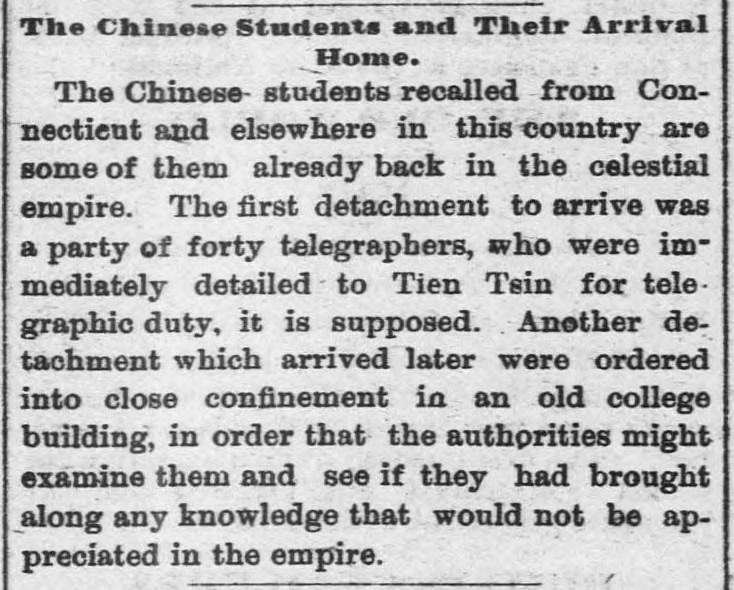
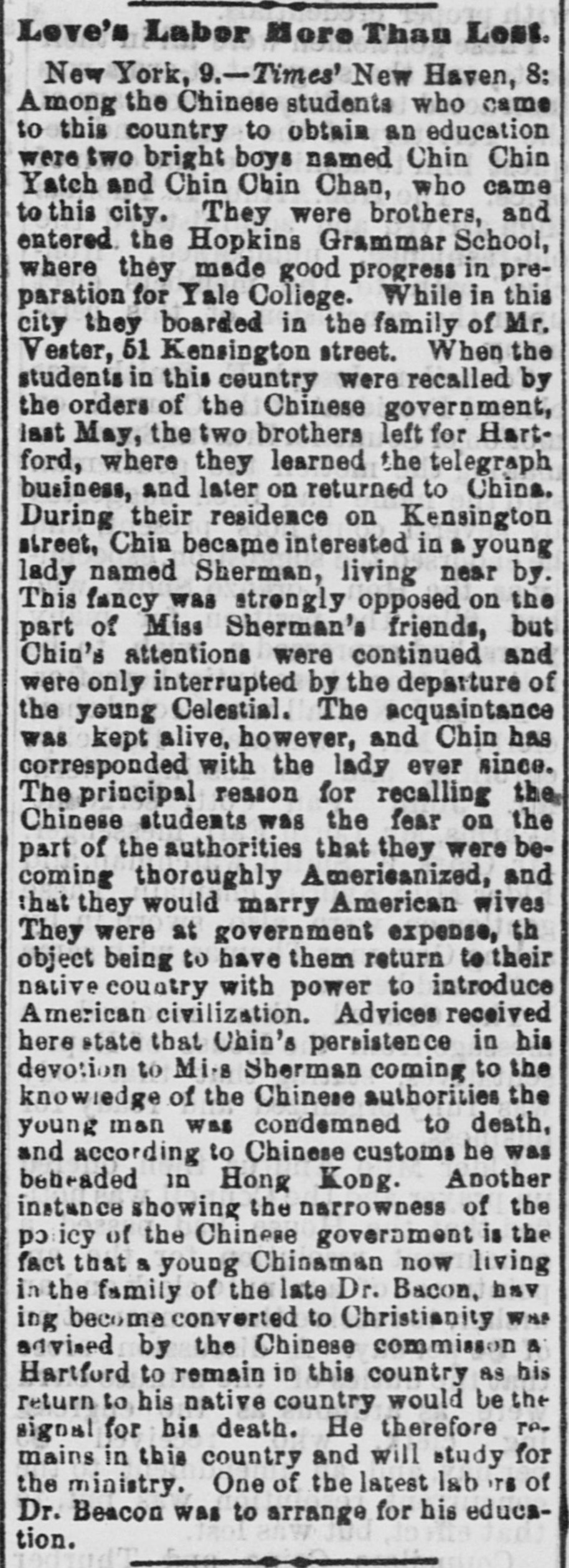
Notice how the article treats the recall as administrative news: students as units to be deployed. The political controversy ("CEM: Political Controversy" sub-topic) often took a more sentimental form, focused on individual students who refused to return: "Among the Chinese students who came to this country to obtain an education were two bright boys named Chin Chin Yatch and Chin Chin Chan, who were brothers. They entered the Hopkins Grammar School where they made good progress in preparation for Yale College… When the students in this country were recalled by the orders of the Chinese government, these two boys refused to go."[2]
The discourse also captured the cultural-adjustment moments that followed the recall: "The young Chinese students who have been recalled by the home government and who made a halt in San Francisco on their way attracted much attention in that city by the fashionable cut of their clothes and their general appearance of elegance and refinement. They especially provoked the admiration of their compatriots in the Chinese quarter, who evidently regarded them as beings of a superior order."[3]
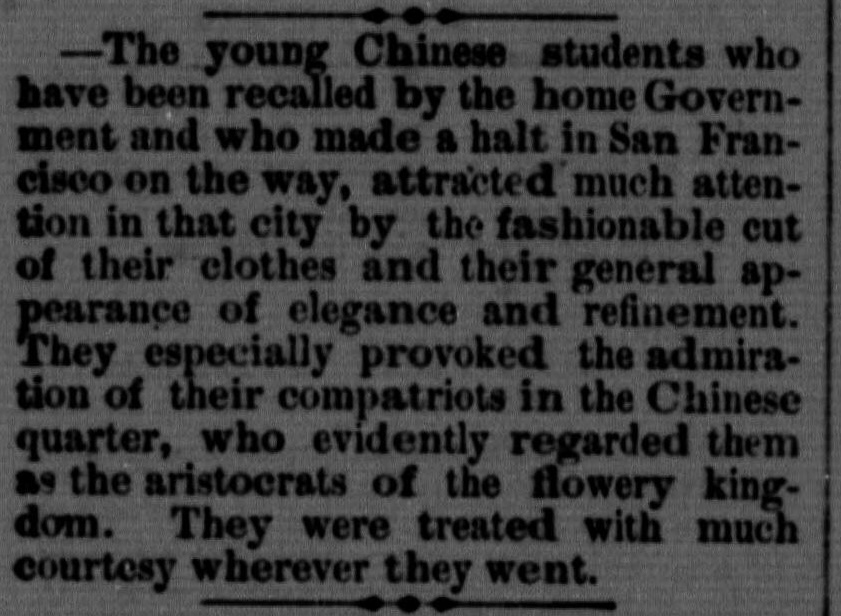
The recalled students appear here neither as victims nor as policy objects but as figures of acculturation, already changed by their American years.
The Public School Admission discourse centered on legal and bureaucratic decisions. Beyond the Tape v. Hurley coverage discussed earlier, the topic captured the everyday administrative refusals that produced the legal cases in the first place: "In response to an inquiry, W. T. Welcker, superintendent of public instruction in California, has written a letter in which he holds that Chinese children cannot legally be admitted to the public schools of that State. While admitting that there is no direct legal prohibition to this effect, he argued that as the provisions of the State constitution…"[4]
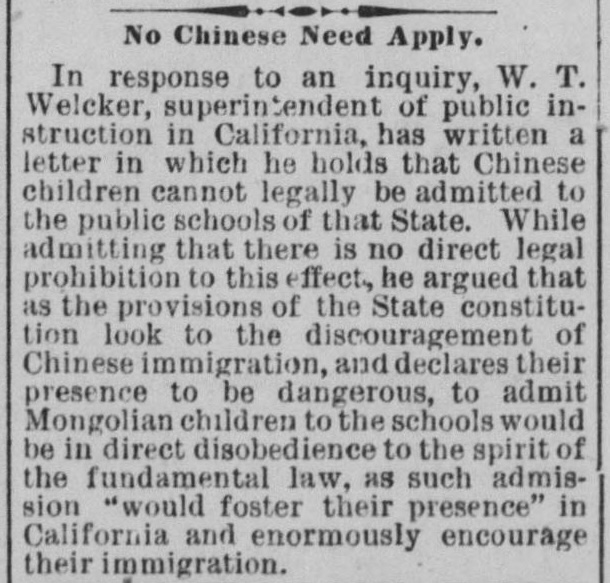
The bureaucratic-legal register is unmistakable: officials, opinions, constitutional argument. This is education discussed as a question of citizenship and law.
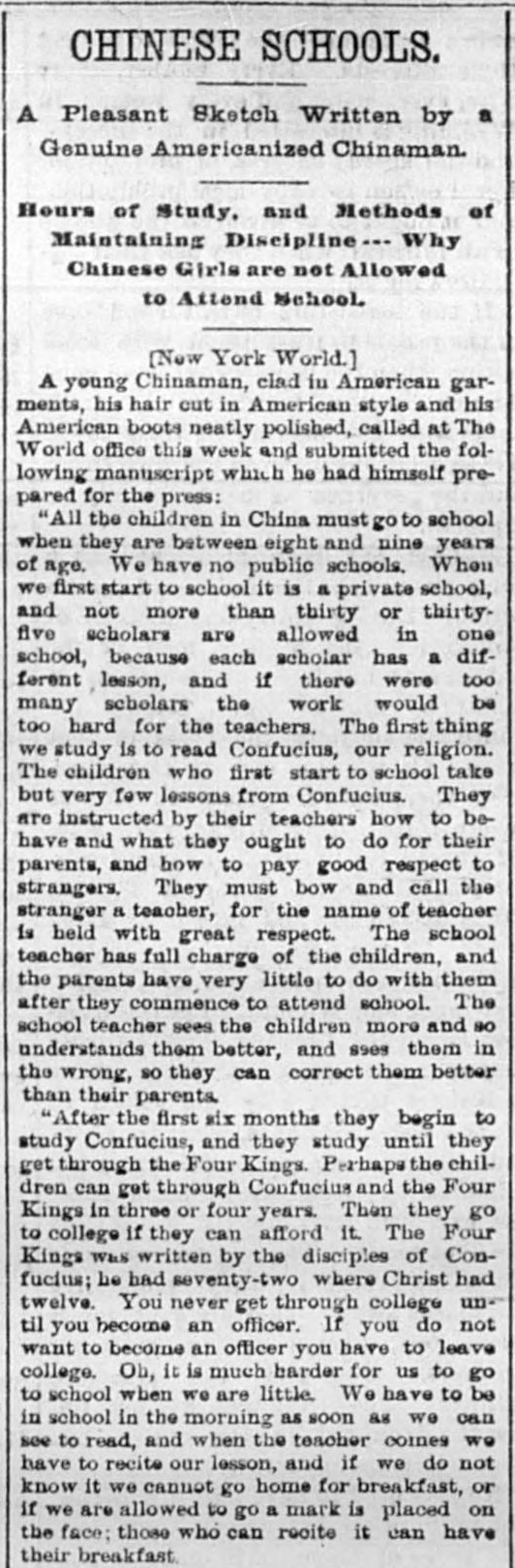
The Classroom Instruction discourse was the most descriptive and ethnographic of the four. It produced articles that explained what Chinese education looked like, sometimes in China and sometimes in American mission schools: "All the children in China must go to school between eight and nine years of age. We have no public schools. When we first start to school, it is a private school, and not more than thirty or thirty-five scholars are allowed in one school, because each scholar has a different lesson."[5]
Other articles in the same topic took a comparative tone: "Very much is thought of education in China, and if a poor boy takes literary honors he can fill as high a position as though he were a boy of rank. All boys, especially in the south of China, are expected to go to school; but besides mission schools, there are not many for girls. A tutor has not only to teach boys how to read and write, but politeness and morality."[6]
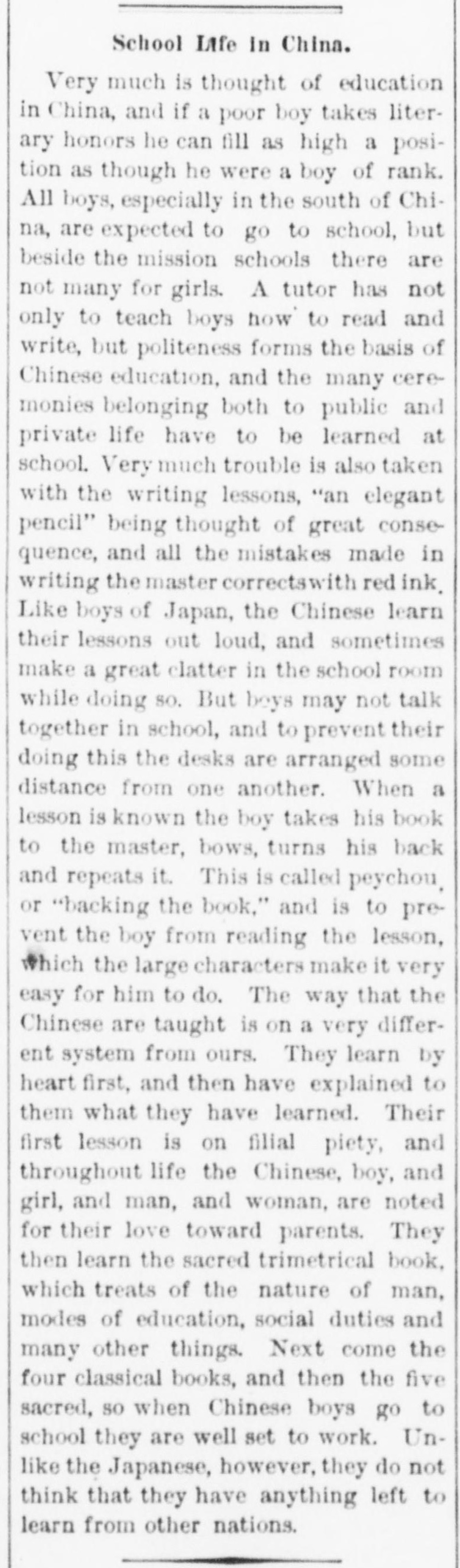
The framing presents Chinese pedagogy as a curiosity worth describing, often with implicit comparison to American common-school ideals.
The Missionary & Church Schools discourse emphasized the Christian transformation of Chinese children, particularly girls. The most representative documents include detailed descriptions of mission school recruitment: "The Ohio Wesleyan University at Delaware has just admitted into the school a girl who has come all the way from China to be educated in Ohio. Miss Hu Kong Eng is the daughter of the Rev. Hu Kong… She is a bright, intelligent young woman of eighteen, and speaks English well."[7]
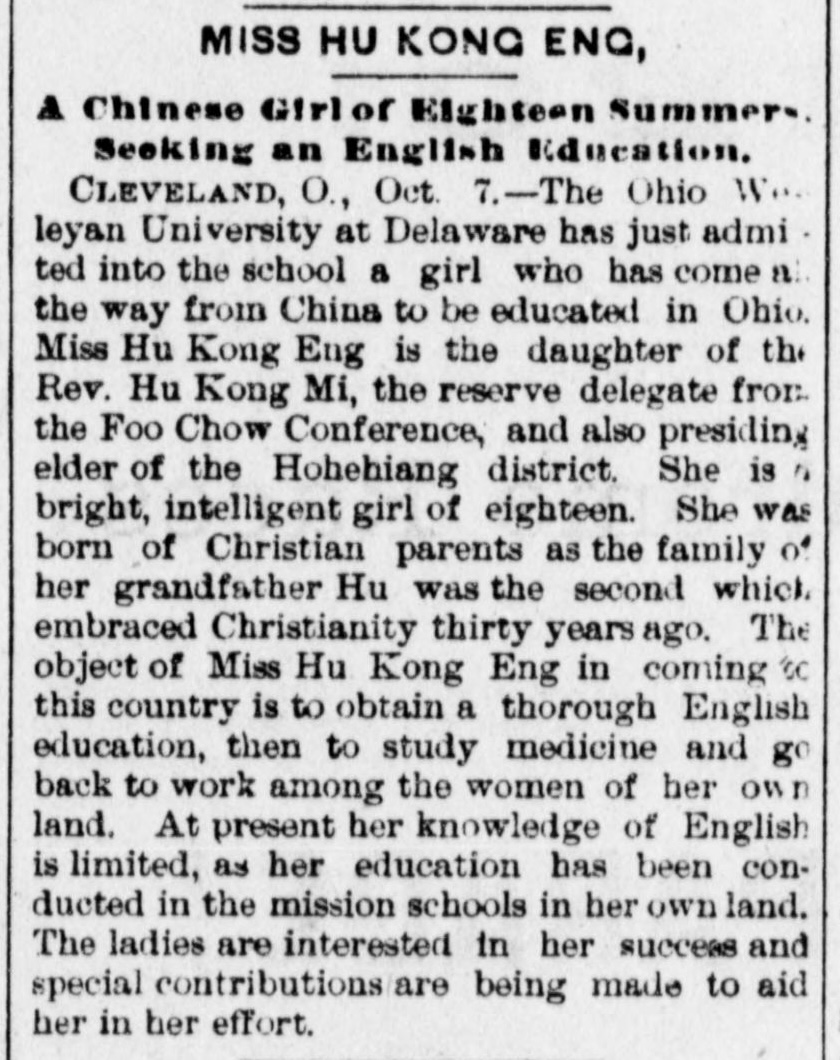
The article foregrounds the girl's intelligence, her English, and crucially her Christian-minister father, markers of a recruit who had already crossed many of the cultural distances the missionary project was designed to bridge.
Other missionary coverage was more institutional, often appearing as routine news about Sunday-school activities: "A Christmas tree and entertainment was also given at the Methodist Chinese school, corner Fifth and I streets. The school has been in progress about eight months… the recitations and exercises of the scholars were highly commendable."[8]
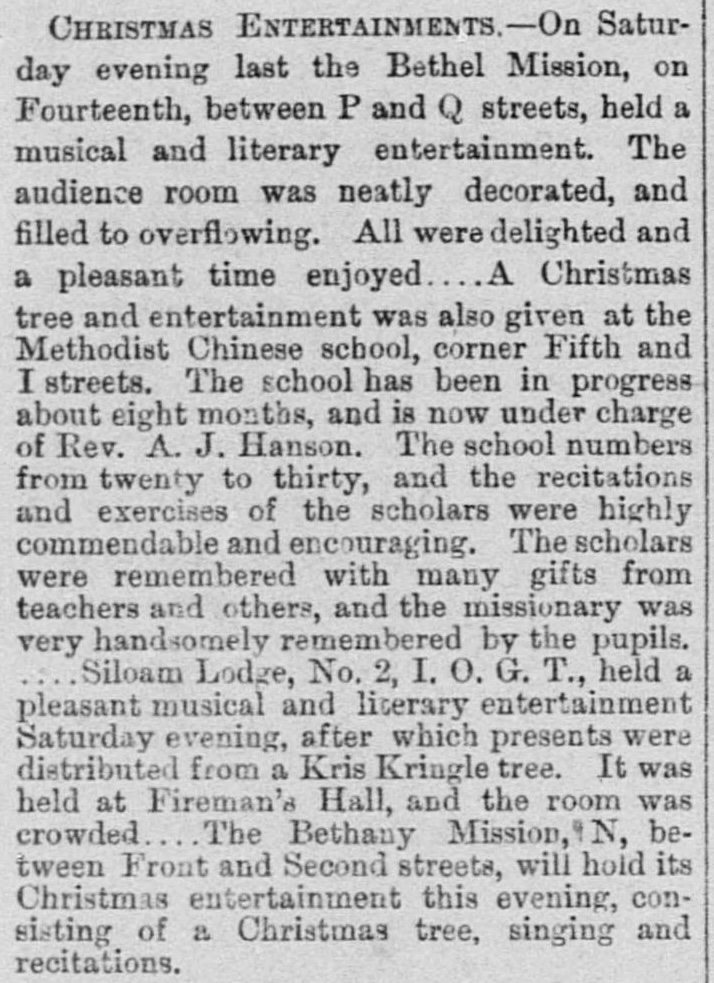
These items treated Chinese children as participants in everyday American religious life, a register that none of the other three education topics captured.
Education as the central terrain
The four discourses are not isolated. They interact, compete, and reorganize each other across time. When the Hartford recall dominated the news in 1881–82, the other three topics were quieter; when CEM faded after 1883, Classroom Instruction grew to fill the space; when Tape v. Hurley hit in early 1885, Public School Admission surged and the others gave way.
What unites all four is that education served as the primary frame through which the American press talked about Chinese children's place in American society. Politics was discussed through the recall and through the school admission cases. Religion was discussed through the mission schools. Cultural difference was discussed through descriptions of Chinese pedagogy. Even violence and exclusion entered the conversation through their effects on Chinese students and Chinese schools.
This is not the only way the conversation could have been organized. Coverage from the same period in newspapers focused on labor, immigration, or commerce talks about Chinese adults very differently: as workers, as a "Chinese question," as a tax base. But when the search vocabulary points at children (students, boys, girls, schools), what comes back is overwhelmingly an educational discourse. The American press in 1880–1885 understood Chinese children primarily through their schooling, their teachers, their potential conversion, and their legal right (or refused right) to a seat in a classroom.
The Hartford mission collapsed in 1881. The Chinese Exclusion Act passed in 1882. Tape v. Hurley was decided in 1885. Across all of these moments, the press kept returning to schools. Education was not a side topic in the discourse about Chinese children. It was the discourse.
Notes
"The Chinese Students and Their Arrival Home," Morning Journal and Courier, November 22, 1881, https://www.loc.gov/resource/sn82015483/1881-11-22/ed-1/?sp=4. ↩︎
"Love's Labor More Than Lost," The Salt Lake Herald, January 10, 1882, https://www.loc.gov/resource/sn85058130/1882-01-10/ed-1/?sp=7. ↩︎
The Jasper Weekly Courier, September 30, 1881, https://www.loc.gov/resource/sn84023963/1881-09-30/ed-1/?sp=7. ↩︎
"No Chinese Need Apply," Charlotte Messenger, April 21, 1883, https://www.loc.gov/resource/sn91068242/1883-04-21/ed-1/?sp=3. ↩︎
"Chinese Schools," The Democratic Leader, February 13, 1884, https://www.loc.gov/resource/sn88067211/1884-02-13/ed-1/?sp=4. ↩︎
"School Life in China," Centre Democrat, October 4, 1883, https://www.loc.gov/resource/sn84009409/1883-10-04/ed-1/?sp=7. ↩︎
"Miss Hu Kong Eng," Daily Evening Bulletin, October 7, 1884, https://www.loc.gov/resource/sn87060189/1884-10-07/ed-1/?sp=3. ↩︎
"Christmas Entertainments," Sacramento Daily Record-Union, December 27, 1880, https://www.loc.gov/resource/sn82014381/1880-12-27/ed-1/?sp=3. ↩︎